When you think “Summer of Love,” you probably don’t think of Carla Bley, the avant-garde composer and pianist who died earlier this week.
Bley was born in Oakland, but moved to New York City in her teens. She would make New York her home base for much of her career, while also cultivating a relationship with her ancestral Scandinavia (Bley’s parents were both first-generation Swedish-Americans), partially through long affiliation with the Euro record label ECM.
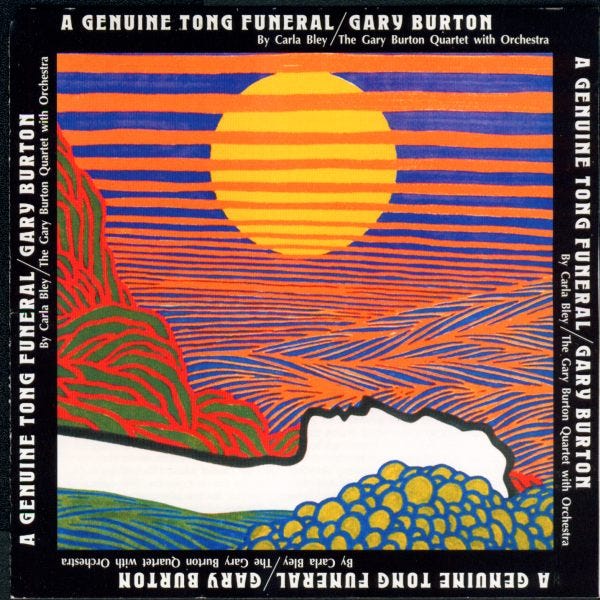
But what is, for me, the most captivating and representative work from Bley’s enormous oeuvre, A Genuine Tong Funeral, was composed in the Bay Area during the Summer of 1967, while the ensemble for which it was conceived, The Gary Burton Quartet, was performing at two legendary psychedelic venues: The Trident in Sausalito and The Fillmore in San Francisco.
At the Fillmore, Burton’s jazz ensemble shared the stage with two bands, Cream and The Electric Flag, who were making albums that would be durably associated with the hope and rage of San Francisco in the late ‘60s.
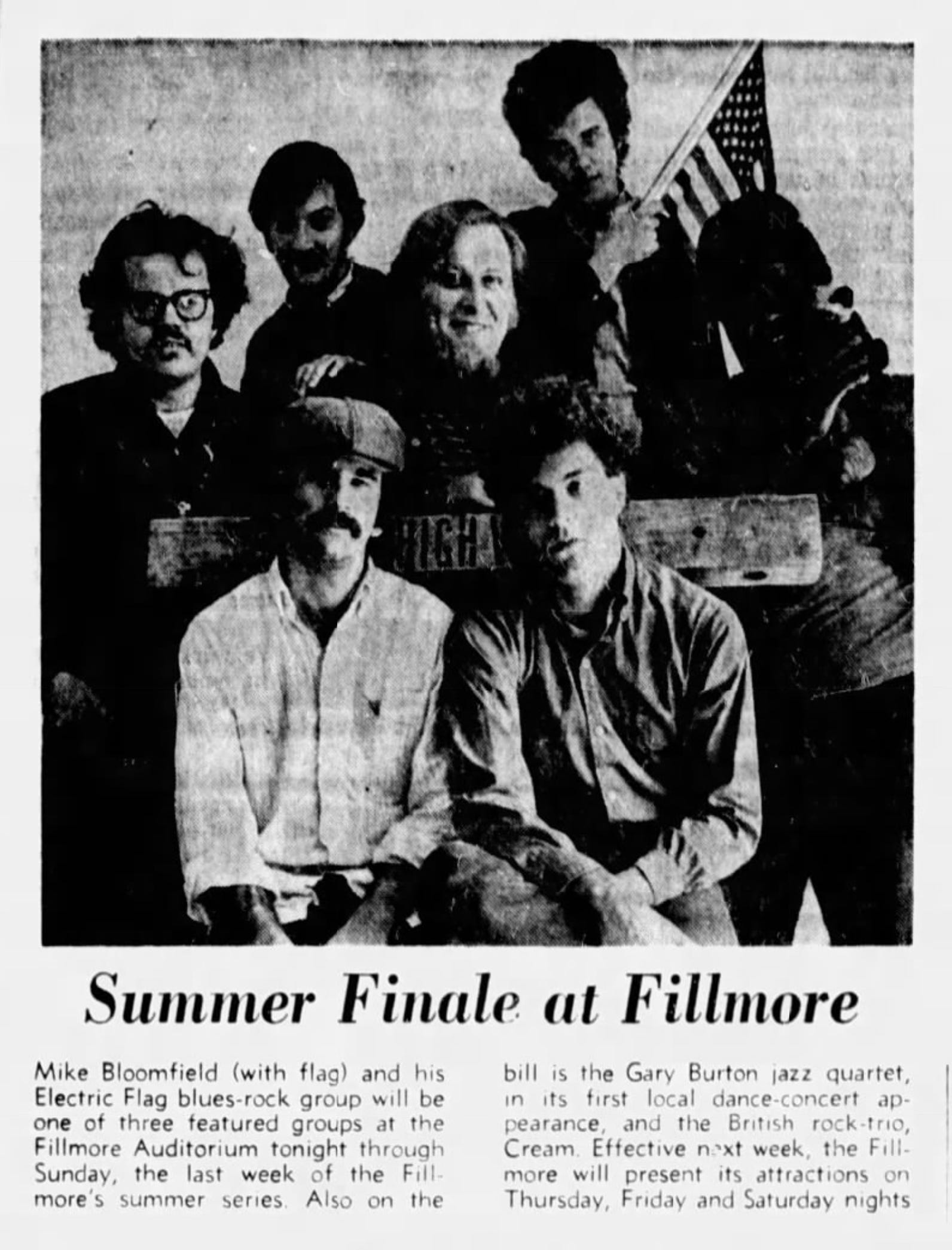
The Electric Flag was then working on the soundtrack for the Roger Corman, Peter Fonda, and Jack Nicholson psychedelic thriller, The Trip (1967), as well as material which would become A Long Time Comin’ (1968) and An All American Music Band (1968)
Cream was performing “Strange Brew,” the first single from Disraeli Gears, which had been recorded in May and would be released in November of 1967 (and also includes “Sunshine of Your Love”). They had also begun the sessions which would become the chart-topping Wheels of Fire (1968) and two additional live albums, all recorded at clubs (including the Fillmore) in San Francisco.


It was while the Burton Quartet was opening for Cream that Bley met that band’s bassist, Jack Bruce, who she would collaborate with for much of the 1970s, perhaps most notably on Escalator Over The Hill (1971), Bley’s jazz opera that also features Linda Ronstadt, Charlie Haden, Don Cherry, John McLaughlin, and most of the horn section (minus Steve Lacy) from A Genuine Tong Funeral.
Bley’s first long-form composition makes numerous subtle allusions to the music of the era, including vague snippets of melodies from Cream’s singles and Sgt. Pepper’s Lonely Hearts Club Band, an album which was ubiquitous during the Summer of Love and which contributed to making Bley “mad at jazz,” as she would later put it.
But, like the Beatles, Bley distinguishes herself from the prevailing San Francisco psychedelic sound by trading appropriation of the Delta blues for an orientalist gaze. Unlike the Beatles, Bley did not require postcolonial tourism to find her inspiration, merely immersion in the Chinese immigrant history of San Francisco.
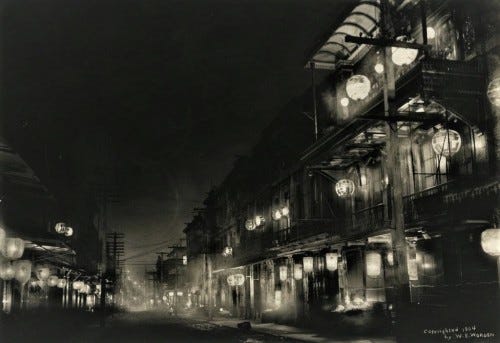
A few years earlier, Richard H. Dillon, a pop historian specializing in California and the The West, had landed on the bestseller list with The Hatchet Men (1962). Billed by the publisher as “the colorful story of a vanished world - San Francisco’s Chinatown in the days of the Tong Wars,” Dillon’s pulpy history introduced Americans to an exoticized variation of the ethnic organized crime narratives then in vogue. The shorthand invocation of Tong (much like Mafioso) for a quasi-criminal syndicate became so common by the mid-1960s that is was liberally used by William Manchester in his Kennedy assassination conspiracy theory, The Death of A President (1967).
But the sensational side of the tong legacy - sex-trafficking, gang violence, opium dens, etc. - played up in the reception (and imitation) of Dillon’s book suppresses the origin story of the tongs, which I think has more relevance to Bley’s album, a meditation on nationalism and death. (One of the central set pieces is titled “Silent Spring,” after Rachel Carson’s 1962 expose which revealed the devastation of bird populations by U.S. pesticide companies.)


The first U.S. tong was founded in San Francisco to act as a countervailing power against the apartheid system which developed in that city and spread across the nation in the second half of the 19th century.
For decades, San Francisco was run by a self-appointed “vigilante committee,” who repeatedly overthrew duly-elected municipal officials, created the professional racketeering force which would become the San Francisco Police Department, and foremost concerned itself with controlling the two largest immigrant communities in the city: the Irish, who were a threat to the vigilantes political power, and the Chinese, who were a threat to their economic power.
The programmatic oppression of the Chinese via violent intimidation, disenfranchisement, and exploitation was codified in a series of municipal laws that were then emulated in the federal Chinese Exclusion Acts of the 1880s and 1890s, which denied even the Chinese-Americans born in the United States access to elections, courts, and other rights of citizenship. This apartheid system would remain law until World War II.
The tongs were community organizations, sometimes even alluded to as “secret societies,” which aggregated the interests of the surrounding community and organized on their behalf, sometimes negotiating with city officials and business leaders. The main lever the tongs used was the undeniable commercial power of the Chinese community, who by withholding their labor, their purchasing power, or their retail, could create fiscal crises in the city and even the surrounding region.
Tong’s could also organize guerrilla operations, undoubtedly, but it was the solidarity of a Chinese community around the tong which white San Franciscans came to fear and respect. The most active port city on the West Coast could be severely compromised by a tong-orchestrated boycott or strike.
Carla Bley’s dark, even morbid, concept album contains within it something comic, and even vaguely hopeful. For instance, she chooses “morning” over “mourning” to describe the wailing sounds made by the procession of survivors. It is, on the one hand, music which captures the grizzly fatalism and permanent threat of violence which hang over a community under apartheid. But it is also homage to the creative forms of fellowship and resistance that develop amongst the oppressed.