
Apple Podcasts | Spotify
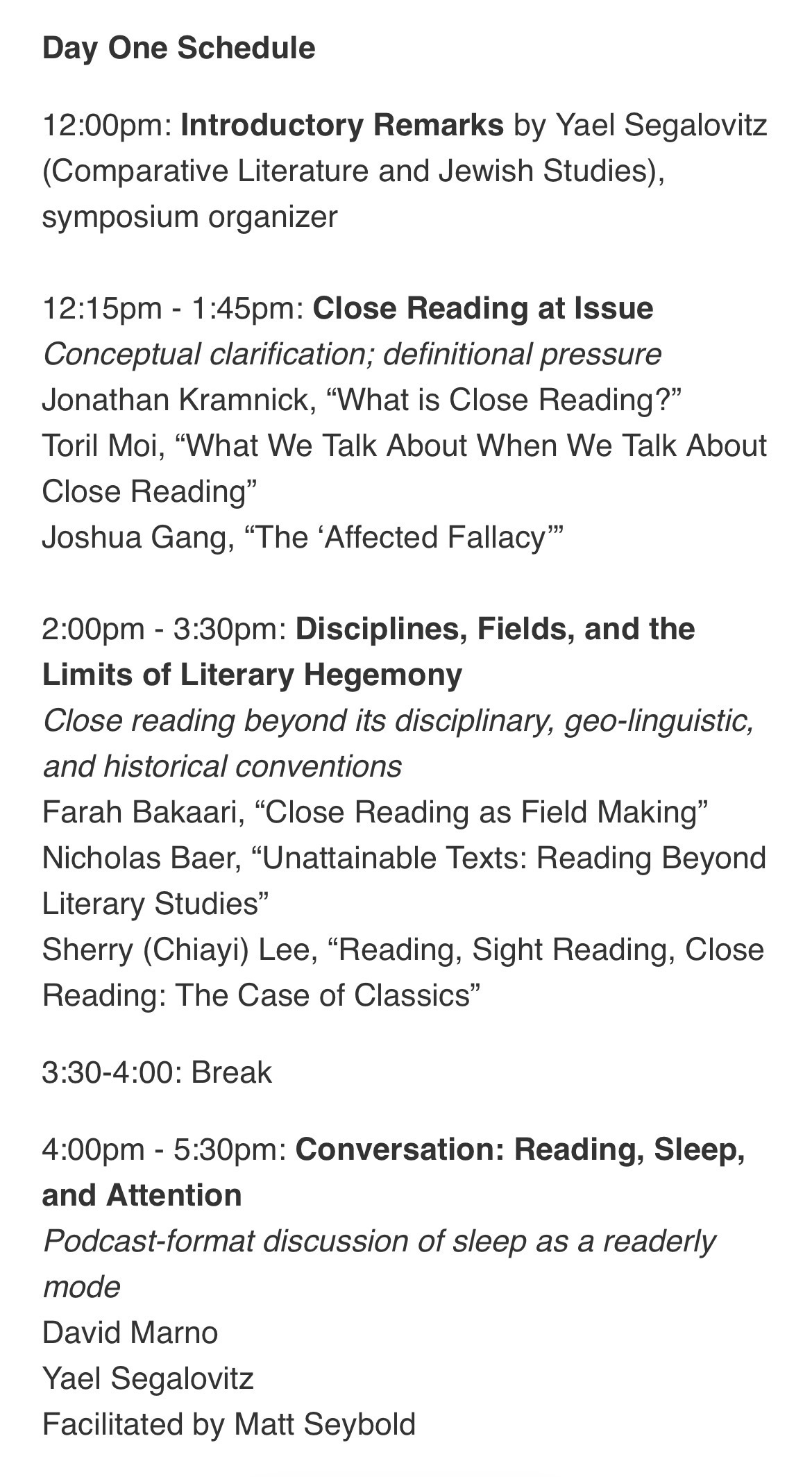
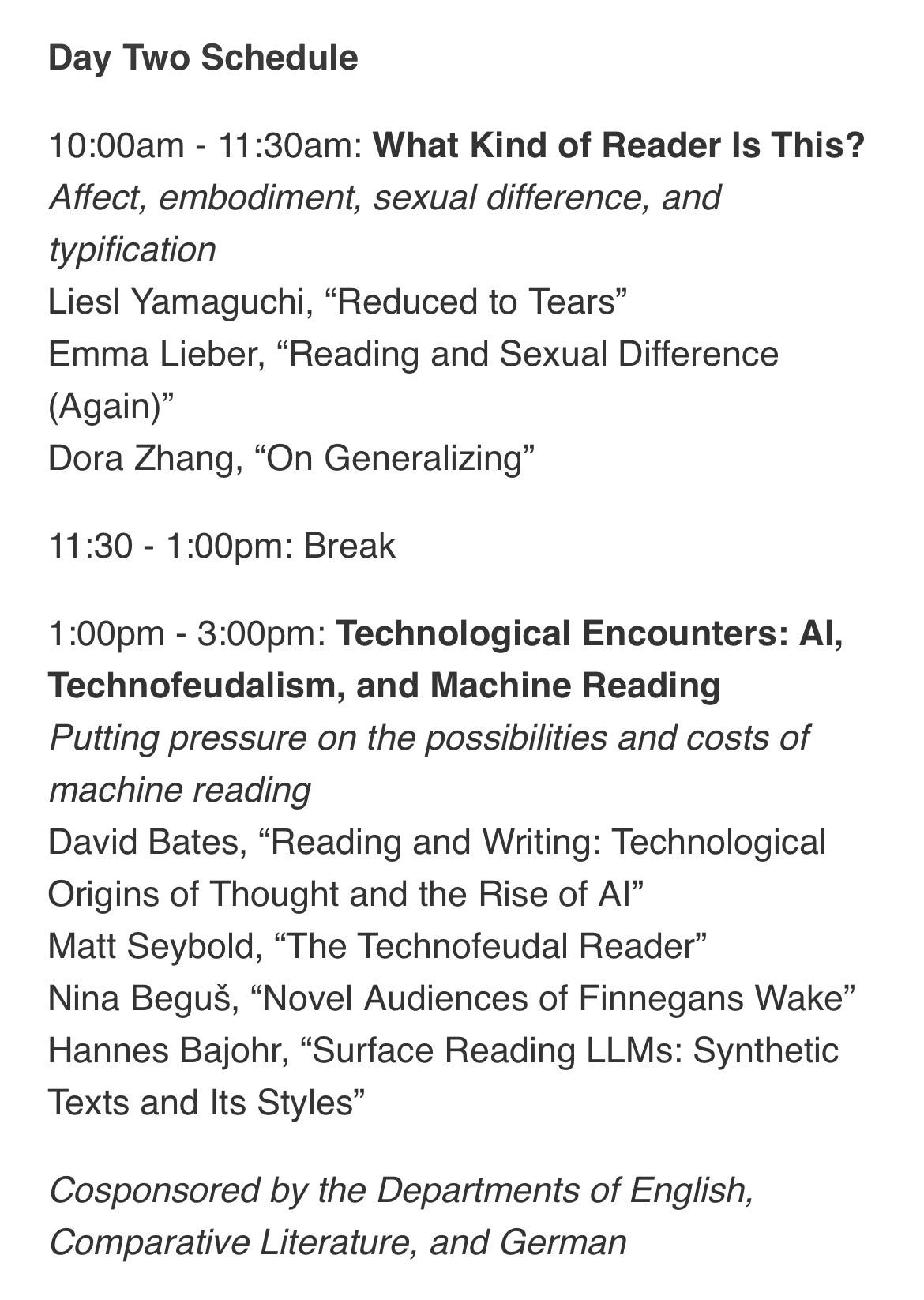
The second episode derived from the Modes of Reading Today Symposium, hosted by the Townsend Center For The Humanities assesses what it means that “close reading is having a moment” through papers titled “What is Close Reading?” [8:00], “Finding The Right Place For Close Reading” [30:00], “The Affected Fallacy” [56:00], “On Generalizing” [77:30], and “Close Reading as Field-Making” [100:00]
Cast (in order of appearance): Yael Segalovitz, Matt Seybold, Jonathan Kramnick, Toril Moi, Joshua Gang, Dora Zhang, Farah Bakaari
Dates Recorded: February 19-20, 2026
Music: Danny Weiss Quartet, Moby
Featured Guests
Farah Bakaari is Assistant Professor of English at University of California, Berkeley and the founding editor of Mid Theory Collective.
Joshua Gang is Associate Professor of English at Berkeley and the author of Behaviorism, Consciousness, and The Literary Mind (Johns Hopkins UP, 2021).
Jonathan Kramnick is the Maynard Mack Professor of English at Yale University and the author of Criticism & Truth: On Method in Literary Studies (U. Chicago, 2023).
Toril Moi is the James B. Duke Distinguished Professor of Literature at Duke University and the author of an important review essay related to close reading, “Crisis In The Profession, or The Failure to Imagine The New” in American Literary History (Winter 2024).
Yael Segalovitz is the Helen Diller Institute Visiting Professor of Comparative Literature at UC-Berkeley and the author of How Close Reading Made Us: The Transnational Legacies of New Criticism (SUNY Press, 2024). She is also the co-host, with Emma Lieber, of the Psychoanaliterature podcast.
Dora Zhang is Associate Professor of English at Berkeley and the author of Strange Likeness: Description in The Modernist Novel (U. Chicago, 2020).
Matt Seybold is Associate Professor of American Literature & Mark Twain Studies at Elmira College, as well as resident scholar at the Center For Mark Twain Studies and executive producer of The American Vandal Podcast.
Episode Bibliography
Bhen Alan, “Why Does My Adobo Taste Different?” Syracuse University Art Museum (2024)
Erich Auerbach, Mimesis (1946)
Farah Bakaari, “First as Tragedy, Second as Farce” Africa is a Country (September 2022)
Stephen Best & Sharon Marcus, “Surface Reading: An Introduction” Representations (Fall 2009)
Cleanth Brooks, The Well Wrought Urn (1947)
NoViolet Bulawayo, Glory (Viking, 2022)
Percival Everett, Erasure (2001)
Henry Fielding, Joseph Andrews (1742)
Northrop Frye, Anatomy of Criticism (1957)
Catherine Gallagher, “The Rise of Fictionality” in The Novel: History, Geography, & Culture (Princeton UP, 2006)
Catherine Gallagher & Stephen Greenblatt, Practicing New Historicism (U. Chicago, 2000)
Jane Gallop, “The Ethics of Reading: Close Encounters” Journal of Curricular Theorizing (2000)
Jane Gallop, “The Ethics of Close Reading” symploke (2024)
Gérard Genette, Narrative Discourse: An Essay in Method (1972) [1980 Cornell UP English Edition]
John Guillory, On Close Reading (U. Chicago, 2025)
O. B. Hardison, “Commentary” in Aristotle’s Poetics: A Translation & Commentary for Students of Literature (Prentice-Hall, 1968) [Trans. Leon Golden]
Eric Hayot, On Literary Worlds (Oxford UP, 2012)
Fredric Jameson, “Third-World Literature in the Era of Multinational Capitalism” Social Text (Autumn 1986)
Maxine Hong Kingston, The Woman Warrior (Knopf, 1976)
Maxine Hong Kingston, “Cultural Mis-readings by American Reviewers” in Asian & Western Writers in Dialogue (Palgrave, 1982)
Jonathan Kramnick, Criticism & Truth: On Method in Literary Studies (U Chicago, 2023)
Jonathan Kramnick, “Response To Review Forum on Criticism & Truth” Modern Language Quarterly (December 2025)
Liam Kruger, “Literary Value & The Prizewinning African Novel” Novel (May 2025)
R. F. Kuang, Yellowface (HarperCollins, 2023)
Caroline Levine, Forms: Whole, Rhythm, Hierarchy, Network (Princeton UP, 2017)
Walter Lippmann, Public Opinion (1922)
György Lukács, Theory of The Novel (1916) [MIT Press Edition]
György Lukács, “The Novel As Bourgeois Epic” (1934)
György Lukács, The Historical Novel (1937) [1983 University of Nebraska Edition]
David Marno, Death Be Not Proud: The Art of Holy Attention (U Chicago, 2016)
Toril Moi, “Crisis In The Profession, or The Failure to Imagine The New” in American Literary History (Winter 2024)
G. E. Moore, Principia Ethica (1903)
Ngũgĩ wa Thiong'o Wizard of the Crow (Harvill Secker, 2006)
Frank O’Hara, “Lana Turner has collapsed!” (1964)
I. A. Richards, Practical Criticism (1929)
I. A. Richards & C. K. Ogden, The Meaning of Meaning (1923)
Paul Saint-Amour, “The Medial Humanities: Toward A Manifesto For Meso-Analysis” Modernism/modernity (February 1, 2019)
Yael Segalovitz, How Close Reading Made Us: The Transnational Legacies of New Criticism (SUNY Press, 2024)
Matt Seybold et al, “Close Reading For The 21st Century” The American Vandal (February 10, 2026)
Matt Seybold et al, “Close Reading Is A Conversation” The American Vandal (February 18, 2026)
Matt Seybold et al, “The Racist Interpretation Complex” The American Vandal (August 28, 2023)
Matt Seybold, “The Medium Is Not The Method” Modern Language Quarterly (March 2025)
C. L. Stevenson, Ethics and Language (1944)
William K. Wimsatt, The Verbal Icon: Studies In The Meaning of Poetry (1954)
William K. Wimsatt & Monroe C. Beardsley, “The Intentional Fallacy” Sewanee Review (Fall 1946)
William K. Wimsatt & Monroe C. Beardsley, “The Affective Fallacy” Sewanee Review (Winter 1949)
Joan W. Scott, “The Evidence of Experience” Critical Inquiry (Summer 1991)
Dan Sinykin & Johanna Winant (Ed.) Close Reading for the 21st Century (Princeton UP, 2025)
Zadie Smith, “Fascinated To Presume: In Defense of Fiction” New York Review of Books (October 24, 2019)
William Carlos Williams, “The Red Wheelbarrow” (1938) [PennSound]
Johanna Winant, “The Claims of Close Reading” Boston Review (November 26, 2025)
Ludwig Wittgenstein, Philosophical Investigations (1953)
Virginia Woolf, “How Should One Read A Book?” Yale Review (Autumn 1926)
Dora Zhang, “The Mark of The Detail: Universalism, Type, Difference” Modern Language Quarterly (June 2023)
Event Copy