
Apple Podcasts | Spotify
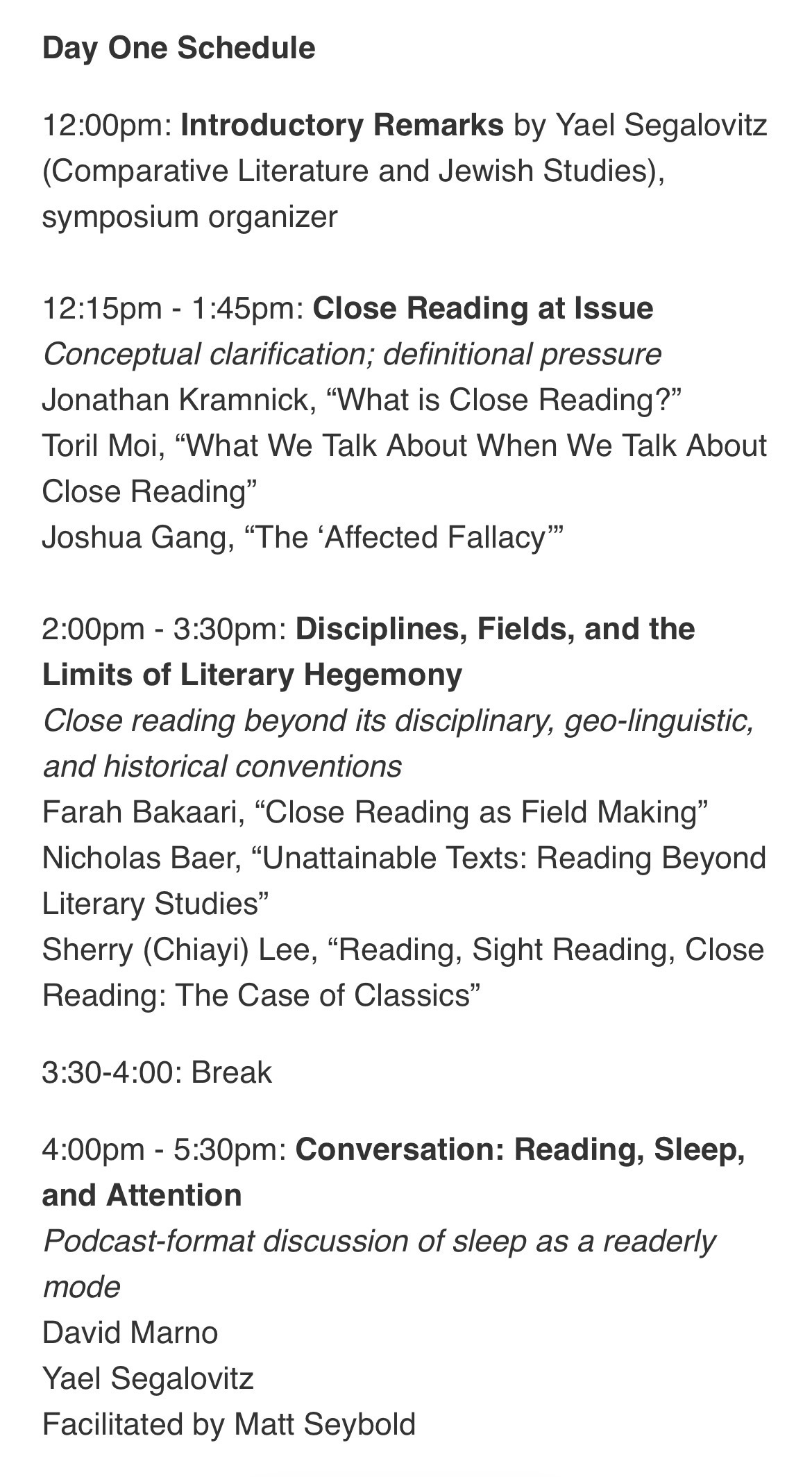
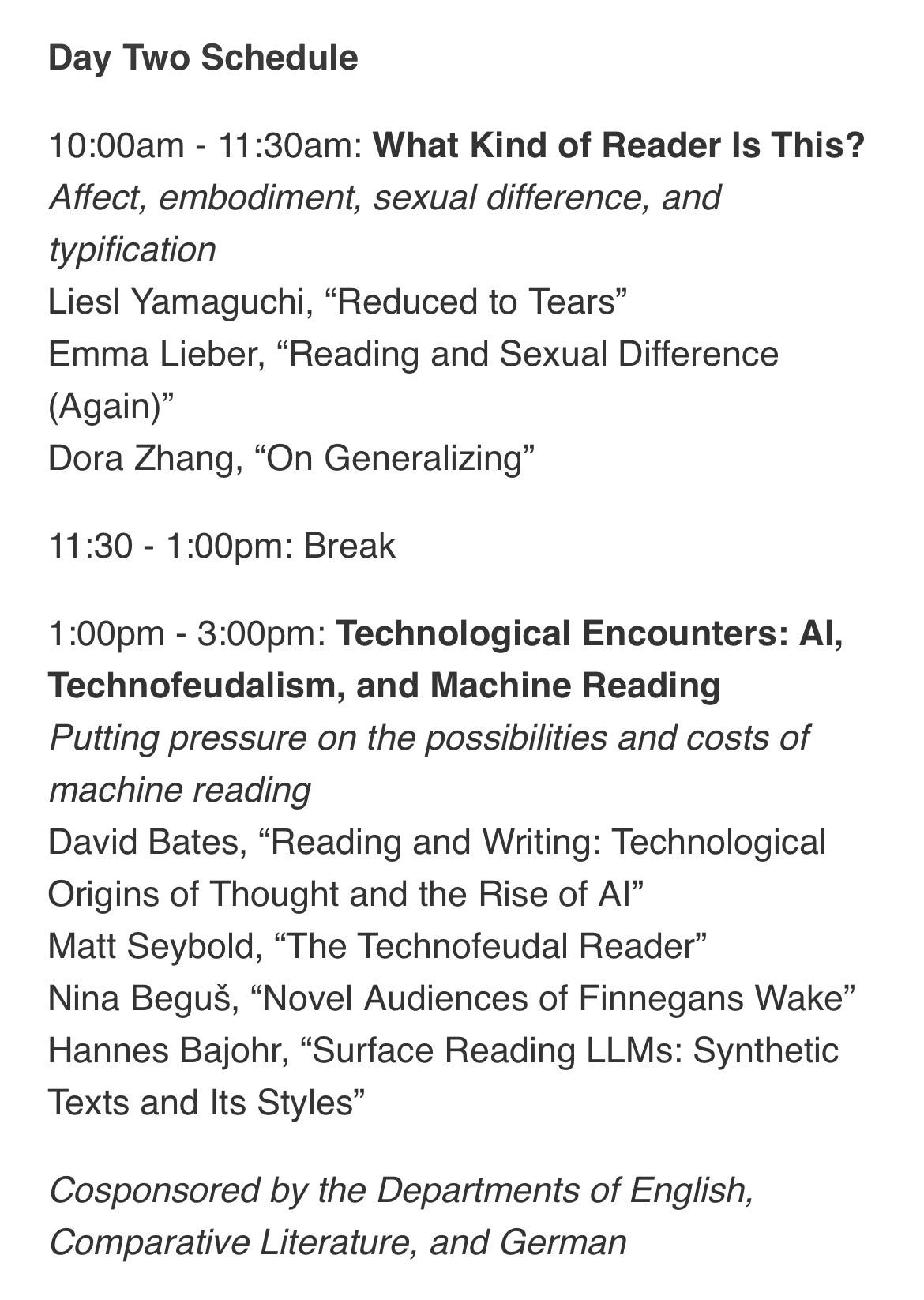
The final episode recorded at the Modes of Reading Today Symposium, hosted by the Townsend Center For The Humanities focuses on media, mediation, and machine-generated texts. It opens with Nicholas Baer and Pardis Dabashi’s “Unattainable Texts,” followed by David Bates’s “Reading and Writing” [20:00], Nina Beguš’s “Novel Audiences in ‘Finnegan’s Wake’” [37:30], Hannes Bajohr’s “Surface Reading LLMs” [57:00], Matt Seybold’s “The Technofeudal Reader” [81:00], and a brief Q&A [100:00].
Cast (in order of appearance): Yael Segalovitz, Nicholas Baer, David Bates, Nina Beguš, Hannes Bajohr, Matt Seybold, Jacob Gaboury, Deniz Göktürk, Jonathan Kramnick
Dates Recorded: February 19-20, 2026
Music: Danny Weiss Quartet, Moby
Featured Speakers
Nicholas Baer is Associate Professor in the Department of German and the Department of Film & Media at UC-Berkeley, as well as the author of Historical Turns: Weimar Cinema & The Crisis of Historicism (U. California, 2024)
Hannes Bajohr is Associate Professor in the Department of German at UC-Berkeley and the editor of Thinking With AI: Machine Learning The Humanities (Open Humanities, 2025).
David Bates is Professor in the Department of Rhetoric at UC-Berkeley, as well as the author of An Artificial History of Natural Intelligence (U. Chicago, 2024)
Nina Beguš is Assistant Professional Researcher at the Center For Science, Technology, Medicine, & Society, with further affiliation in the Berkeley Institute for Date Science. She is the author of Artificial Humanities: A Fictional Perspective on Language in AI (U. Michigan, 2025)
Yael Segalovitz is the Helen Diller Institute Visiting Professor of Comparative Literature at UC-Berkeley and the author of How Close Reading Made Us: The Transnational Legacies of New Criticism (SUNY Press, 2024). She is also the co-host, with Emma Lieber, of the Psychoanaliterature podcast.
Matt Seybold is Associate Professor of American Literature & Mark Twain Studies at Elmira College, as well as resident scholar at the Center For Mark Twain Studies and executive producer of The American Vandal Podcast.
Episode Bibliography
Amanda Anderson, The Way We Argue Now: A Study in The Cultures of Theory (Princeton UP, 2005)
Isaac Asimov, “The Fun We Had” (1951)
Nicholas Baer, Historical Turns: Weimar Cinema & The Crisis of Historicism (U. California, 2024)
Hannes Bajohr, “Artificial & Post-Artificial Texts: On Machine Learning & The Reading Expectations Towards Literary & Non-Literary Writings” Media Culture & Cultural Techniques (2023)
Hannes Bajohr, (Berlin, Miami) (MIT Press, 2027)
Nina Beguš, First Encounters with AI: Writers on Writing (U. Michigan, 2026)
Nina Beguš, Metahaven, & Gasper Begus, “Latent Spacecraft: Brains, GANs, Finnegans” Antikythera (February 2026)
Raymond Bellour, “The Unattainable Text” Screen (Autumn 1975)
Stephen Best & Sharon Marcus, “Surface Reading: An Introduction”Representations (Fall 2009)
David Bordwell, “Historical Poetics of Cinema” in Cinematic Text: Methods & Approaches (AMS Press, 1989)
David Bordwell & Noël Carroll (eds.) Post-Theory: Reconstructing Film Studies (U Wisconsin, 1996)
Noam Chomsky, “The Case Against B. F. Skinner” New York Review of Books (December 30, 1971)
Noam Chomsky, [Review of Verbal Behavior] Language (Spring 1959)
Pardis Dabashi, “Introduction to ‘Cultures of Argument’: The Loose Garments of Argument” PMLA (October 2020)
Jodi Dean, Capital's Grave: Neofeudalism & The New Class Struggle (Verso, 2025)
Jacques Derrida, “Plato’s Pharmacy” Tel Quel (1968)
Wai Chee Dimock, “A Theory of Resonance” PMLA (October, 1997)
Jeff Dolven, Senses of Style: Poetry Before Interpretation (U. Chicago, 2017)
Todd Feather, “Parents Fell In Love With Alpha School’s Promise. Then They Wanted Out.” Wired (October 27, 2025)
Jane Gallop, “The Ethics of Reading: Close Encounters” Journal of Curricular Theorizing (2000)
Jane Gallop, “The Ethics of Close Reading” symploke (2024)
John Guillory, On Close Reading (U. Chicago, 2025)
Lucas Hilderbrand, “The Big Picture: On The Expansiveness of Cinema & Media Studies” Cinema Journal (Winter 2018)
Jared Cooney Hovrath, “The EdTech Revolution Has Failed” After Babel (November 12, 2024)
James Joyce, Finnegan’s Wake (1939)
Immanuel Kant, Anthropology From A Pragmatic Point of View (1798)
Immanuel Kant, “On The Injustice of Counterfeiting Books” (1785)
Friedrich Kittler, Gramophone, Film, Typewriter (Stanford UP, 1999)
Jonathan Kramnick, Criticism & Truth: On Method in Literary Studies (U Chicago, 2023)
Jonathan Kramnick, “Response To Review Forum on Criticism & Truth”Modern Language Quarterly (December 2025)
Marjories Levinson, “What Is New Formalism?” PMLA (March, 2007)
Pierre Levy, “Artificial Reading” SubStance (1997)
Deirdre McCloskey, “Measured, Unmeasured, Mismeasured, & Unjustified Pessimism: A Review Essay of Thomas Piketty’s Capital In The 21st Century”Erasmus Journal for Philosophy & Economics (Autumn 2014)
D. A. Miller, “Hitchcock’s Understyle: A Too-Close View of Rope” Representations (Winter 2013)
Toril Moi, “Crisis In The Profession, or The Failure to Imagine The New” in American Literary History (Winter 2024)
Laura Mulvey, Death 24x a Second: Stillness & The Moving Image (Reaktion Books, 2006)
Laura Mulvey, “Visual Pleasure & Narrative Cinema” Screen (Autumn 1975)
Bill Nichols (ed.) Movies & Methods: Volume 1 (U California, 1976)
Fabian Offert & Ranjodh Singh Dhaliwal, “The Method of Critical AI Studies, A Propaedeutic” (December 10, 2024)
Walter J. Ong, Orality & Literacy: The Technologizing of The Word (1982)
Karl Popper, Objective Knowledge: An Evolutionary Approach (1972)
Bo Ruberg & Elizabeth Ellcessor, “Yes, It Is Media: Introduction To The Special Issue” Journal of Cinema & Media Studies (Fall 2025)
Pooja Salhotra, “AI-Driven Education: Founded In Texas & Coming To A School Near You” New York Times (July 27, 2025)
Eve Kosofsky Sedgwick, “Paranoid Reading & Reparative Reading; or, You’re So Paranoid, You Probably Think This Introduction Is About You” Novel Gazing: Queer Readings of Fiction (Duke UP, 1997)
Yael Segalovitz, How Close Reading Made Us: The Transnational Legacies of New Criticism (SUNY Press, 2024)
Matt Seybold, “The Technofeudal Text” The American Vandal (August 25, 2025)
Matt Seybold et al, “Close Reading Is Having A Moment” The American Vandal (July 7, 2026)
Matt Seybold et al, “Close Reading For The 21st Century” The American Vandal (February 10, 2026)
Matt Seybold et al, “Close Reading Is A Conversation” The American Vandal (February 18, 2026)
Matt Seybold et al, “The Racist Interpretation Complex” The American Vandal (August 28, 2023)
Matt Seybold, “The Medium Is Not The Method” Modern Language Quarterly (March 2025)
Dan Sinykin & Johanna Winant (Ed.) Close Reading for the 21st Century (Princeton UP, 2025)
Antonio Somaini, “Algorithmic Images: Artificial Intelligence & Visual Culture” Grey Room (Fall 2023)
Bernard Stiegler, Technics & Time: Vol. 1-3 (Stanford UP, 1998-2010)
Bernard Stiegler, Acting Out (Stanford UP, 2009)
Yanis Varoufakis, Technofeudalism: What Killed Capitalism (Melville House, 2024)
Thorstein Veblen, “The Engineers & The Price System” The Dial (1921)
Johanna Winant, “The Claims of Close Reading” Boston Review (November 26, 2025)
Ludwig Wittgenstein, Philosophical Investigations (1953)
McKenzie Wark, Capital Is Dead: Is This Something Worse? (Verso, 2019)
Maryanne Wolf, Reader, Come Home: The Reading Brain in A Digital World (HarperCollins, 2019)
Event Copy